ARTERIES OF SILK 1271.11
VERNISSAGE
JUNE 4, 2026 - 18h30
EXHIBITION
JUNE 4, 2026 - 18h30
Galerie CAW
5, route de Diekirch L-7220 Walferdange
thursday / friday 15h -19h
saturday/ sunday 14h -18h


The Silk Road was never a single road.
It was a vast network of routes stretching across desert, mountain, and steppe — linking distant cultures through the slow movement of materials, people, and ideas. Caravans crossed Central Asia carrying silk, spices, woods, citrus, and pigments, their journeys measured not in days, but in seasons.
In 1271, under the rule of Kublai Khan, the Yuan dynasty was formally established. Across much of Eurasia, the territories of the Mongol Empire created an unusual continuity of passage — a period often referred to as the Pax Mongolica.
For a time, distance became traversable.
Materials moved across continents — folded, stored, exchanged, and handled repeatedly across climates. Their surfaces absorbed time, scent, and contact. These movements form the conceptual foundation of this body of work.
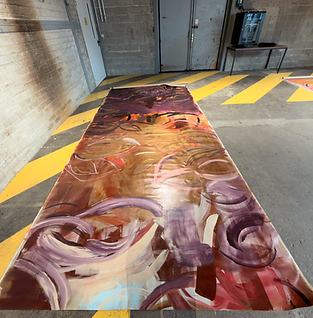
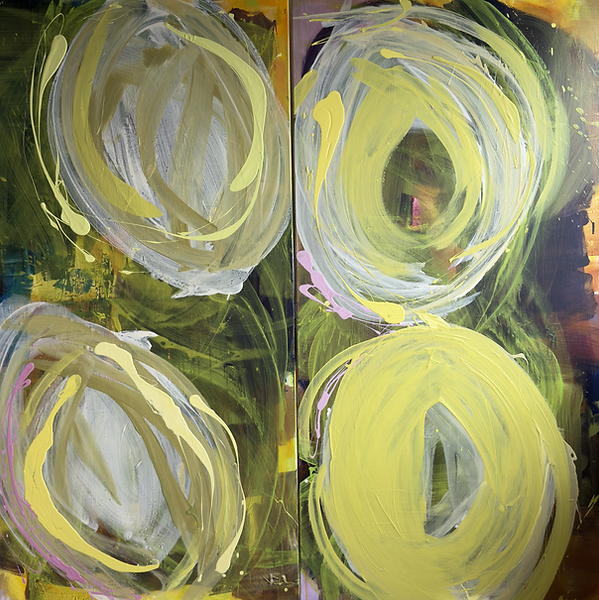
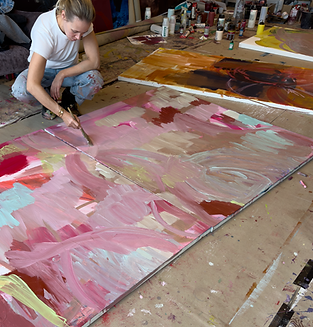
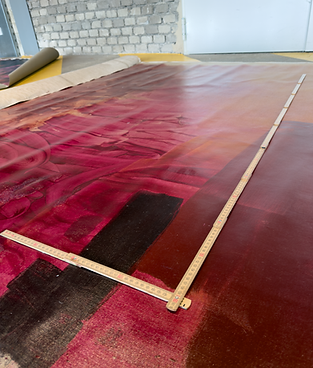
The paintings do not depict specific journeys or places. Instead, they trace movement itself — through layered surfaces, abrasion, and repetition. Pigment is applied, removed, and reapplied, echoing the accumulation and erosion that defined travel along these routes.
This exhibition unfolds across four rooms.
The first introduces the idea of passage and distance.
The following rooms are grounded in three materials historically carried along the Silk Road: citron, saffron, and sandalwood — fruit, flower, and wood.
Each material holds a distinct colour, density, and scent — elements once transported across vast distances, stored among textiles, resins, and spices. These materials shaped both trade and atmosphere, influencing how goods, spaces, and bodies carried scent across time.
To deepen this sensory dimension, the exhibition includes a collaboration with the Paris-based perfume atelier Candora.
Together, three distinct fragrances were developed — citron, saffron, and sandalwood — each corresponding to a room within the exhibition. The paintings within these spaces are inspired by the material qualities and chromatic presence of each element. The scents do not illustrate the works; rather, they extend them, creating an atmospheric field in which visual and olfactory memory intersect.
The number 1271 resolves numerologically to 11 — two vertical forms, like parallel paths or thresholds.
A passage held open.
What once moved across land is gathered here in material form — not as map or illustration, but as trace.
A record not of routes, but of transformation.